
Table of Contents
- Why Bathroom Vanity Materials Fail Faster Than Kitchen Ones
- How We Score Durability in Bathroom Vanity Materials
- 1. Quartz: The Most Durable Countertop for a Vanity
- 2. Quartzite: Natural Stone Performance Without Marble’s Weakness
- 3. Porcelain and Sintered Stone: Thin, Non-Porous, and Tough
- 4. Plywood and Solid Wood Cabinets: The Cabinet Side of Durability
- MDF vs. Plywood Bathroom Vanity: What Actually Survives Humidity
- Quartz vs. Granite Bathroom Countertop: Which Holds Up Better
- Frequently Asked Questions
Last Updated: October 14, 2026
Why Bathroom Vanity Materials Fail Faster Than Kitchen Ones
A bathroom vanity lives a harder life than any kitchen counter. Steam from every shower, splashes at the sink, and towels left damp on the surface all take a toll. That daily moisture cycle is why bathroom vanity materials fail faster than kitchen surfaces, even when the same stone or wood is used in both rooms.
This guide ranks the five best bathroom vanity materials for durability. We separate countertop materials from cabinet materials, because they fail for different reasons.
Below, we score each option on water resistance, scratch and stain resistance, repairability, and lifespan.
How We Score Durability in Bathroom Vanity Materials
We score every material on five factors, each worth up to 2 points:
- Water and moisture resistance: how well it handles steam and standing water
- Scratch and stain resistance: daily wear from toothpaste, soap, and cosmetics
- Heat resistance: protection from curling irons and hot tools
- Repairability: whether damage can be fixed or means full replacement
- Lifespan: realistic service life in a wet room
| Material | Water Resistance | Scratch/Stain | Repairability | Best Use |
|---|---|---|---|---|
| Quartz | Excellent | Excellent | Poor | Countertops |
| Quartzite | Very good | Very good | Moderate | Countertops |
| Porcelain | Excellent | Excellent | Poor | Countertops |
| Plywood | Good | Moderate | Good | Cabinets |
| Solid wood | Moderate | Moderate | Excellent | Cabinets |
A high score on the countertop side does not transfer to the cabinet side. Keep the two separate.
The most common vanity failure is not the countertop. It is the cabinet box under it, where moisture gets in at seams and edges.
1. Quartz: The Most Durable Countertop for a Vanity
Quartz is the most durable countertop material for a bathroom vanity. It is an engineered surface made from ground stone mixed with resin, so it is non-porous and never needs sealing. Water, soap, and cosmetics sit on the surface instead of soaking in.
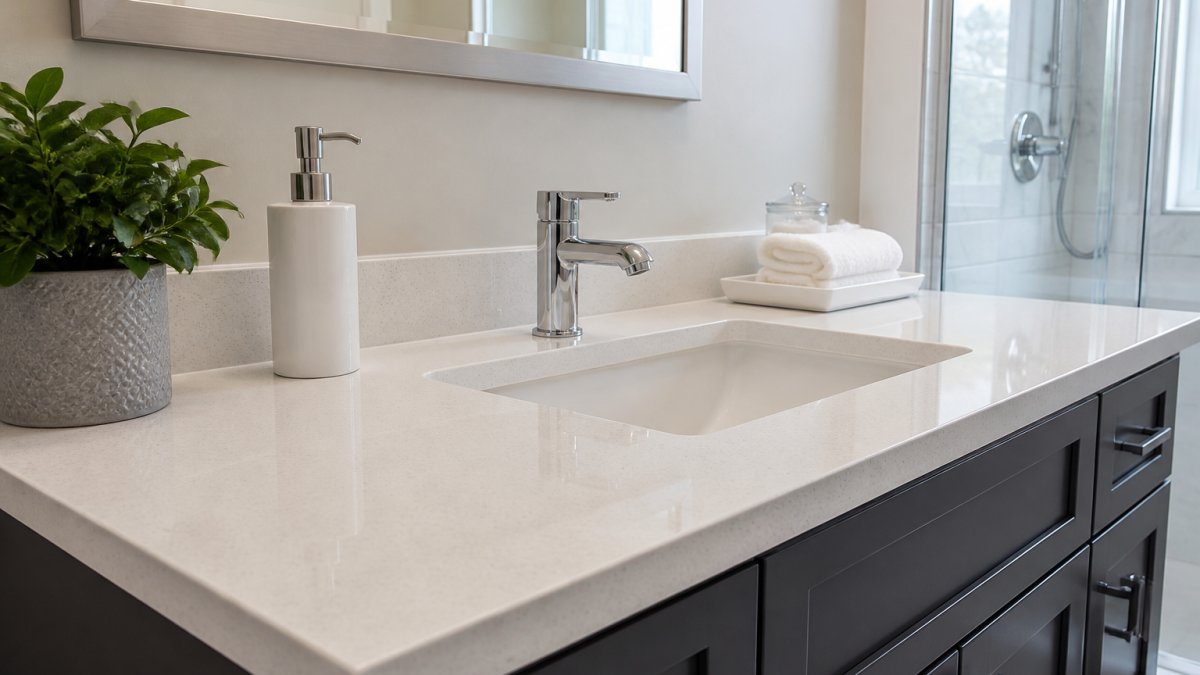
Quartz resists scratches, stains, and heat well. Its weakness is repairability. A chip or burn mark usually means a professional repair or a new slab, because the pattern runs through the whole surface. For a busy family bathroom, that trade-off is usually worth it.
2. Quartzite: Natural Stone Performance Without Marble’s Weakness
Quartzite is a metamorphic stone, sandstone that has been cooked under heat and pressure until the quartz grains recrystallize into an interlocking matrix. That process is why it reads like marble but behaves like granite on the hardness scale. On the Mohs scale, most quartzite lands around 7, which is harder than marble (3-4) and comparable to granite (6-7). In a bathroom, that hardness translates into real scratch resistance against dropped razors, tweezers, and cosmetic jars.
Why quartzite still needs sealing
Quartzite is natural stone, so it is porous at a microscopic level. The pores are small, much smaller than marble’s, but they exist, and they accept water, oils, and pigment if left unsealed. A penetrating sealer fills those pores from the inside without changing the surface look. Most fabricators apply a sealer at installation and recommend re-sealing every 12 to 24 months in a bathroom, where steam and standing water accelerate the breakdown of the sealer film. A simple water-bead test tells you when it is due: drip water on the surface, and if it soaks in within a few minutes instead of beading, reseal.
Bathroom-specific failure modes
- Hard-water spotting: minerals in tap water etch a dull film on unsealed quartzite, especially around the faucet base and soap dish.
- Cosmetic staining: tinted moisturizer, hair dye, and nail polish remover can leave a shadow if they sit overnight on a worn sealer.
- Seam discoloration: the epoxy seam where two slabs meet is the first place sealer wears thin, and it is where grime collects.
Care schedule
- Daily: wipe with a pH-neutral stone cleaner or a drop of dish soap in warm water. Skip vinegar, lemon, and ammonia, acids dull the polish over time.
- Weekly: dry the surface after use so standing water does not sit on the sealer.
- Every 12-24 months: reapply a penetrating sealer. Solvent-based sealers tend to last longer in a wet room than water-based ones.
- As needed: blot stains immediately; do not scrub with abrasive pads.
Trade-offs to weigh
Quartzite costs more than most engineered surfaces, and every slab varies in color and veining, so you cannot order a matching piece later. It is also heavy, a 2 cm slab runs roughly 12-13 lb per square foot, which means the cabinet box and substrate need to be built for the load. For a homeowner who wants natural stone with marble looks and is willing to keep up with sealing, quartzite is the strongest natural option. For someone who wants zero maintenance, quartz wins.
Never confuse quartzite with quartz. They sound alike but behave differently. Quartzite is natural stone that needs sealing; quartz is engineered and does not. Some suppliers also sell “soft quartzite,” which is actually marble in disguise and will etch and stain.
Ask your fabricator for a sealer sample and test it on a scrap piece before the slab is cut. A 10-minute test on an offcut tells you more about stain resistance than any showroom display.
3. Porcelain and Sintered Stone: Thin, Non-Porous, and Tough
Porcelain and sintered stone are the toughest thin surfaces you can put on a vanity. Both are fired at very high heat, which fuses the material into a dense, non-porous sheet. Water, stains, and scratches struggle to leave a mark.
Their strength is also their limit. These surfaces are thin and rigid, so they need a solid, flat substrate and careful installation. Like quartz, they are hard to repair once chipped. They suit modern, minimalist bathrooms where a slim profile matters.
4. Plywood and Solid Wood Cabinets: The Cabinet Side of Durability
Cabinet durability comes down to the box, not the door finish. Plywood is the better choice for a bathroom cabinet. Its layered construction resists warping and swelling when humidity rises. Solid wood looks warm and can be sanded and refinished, but it moves with moisture and can crack or swell over time.
- Plywood: stable in humidity, holds screws well, good lifespan
- Solid wood: beautiful and repairable, but needs a strong finish and good ventilation
Whatever you choose, protect the cabinet from water damage. Seal the sink edges, fix drips fast, and run the exhaust fan during and after showers.
Ask for plywood cabinet boxes with sealed edges. The cut edges of a cabinet box are where water gets in first, and a factory-sealed edge lasts far longer than an open one.
MDF vs. Plywood Bathroom Vanity: What Actually Survives Humidity
Plywood survives humidity in a bathroom vanity far better than MDF. MDF is made from fine wood fibers and resin pressed together. It is smooth and cheap, but its edges soak up water and swell. Once MDF swells, it does not return to shape.
Plywood is built from crossed layers of wood, which makes it more stable when moisture rises. It also holds screws better, so hinges and drawers stay tight longer.
If budget forces MDF, keep it away from the sink and floor, seal every edge, and control ventilation. In a wet room, plywood is the safer bet every time.
Quartz vs. Granite Bathroom Countertop: Which Holds Up Better
Quartz holds up better than granite in a bathroom. Quartz is non-porous and needs no sealing, so it shrugs off water, soap, and stains. Granite is natural stone that is porous and needs regular sealing to stay protected.
Granite still has fans. Each slab is unique, and it handles heat well. But in a steamy bathroom, its porosity is a real weakness. Quartz wins on maintenance, stain resistance, and consistency.
| Factor | Quartz | Granite |
|---|---|---|
| Sealing needed | No | Yes, regularly |
| Stain resistance | High | Moderate |
| Water resistance | High | Moderate |
| Uniqueness | Consistent | One-of-a-kind |
Frequently Asked Questions
Which bathroom vanity material is the most durable?
Quartz and porcelain come out on top for countertops because they are non-porous and resist moisture, staining, and scratches without sealing. For cabinets, plywood outperforms MDF in humid bathrooms because its layered construction handles moisture better and holds screws more securely. The most durable vanity combines a quartz or porcelain top with a plywood cabinet box, which addresses both the surface and the structure.
Is MDF or plywood better for a bathroom vanity?
Plywood is the better choice for bathroom vanities. Its cross-grain layers resist swelling and warping when humidity rises, and it holds hinges and drawer slides more reliably over time. MDF has a smoother surface for painting, but its particle-based core absorbs water quickly at cut edges and around plumbing openings, which is where most bathroom vanity failures start. If MDF is used, every exposed edge needs sealing.
How long should a bathroom vanity last?
A well-built vanity with a quartz or porcelain top and a plywood cabinet typically lasts 15 to 20 years or more with basic care. Solid wood cabinets can last just as long if the finish stays intact. Vanities with MDF boxes or unsealed natural stone often show water damage, swelling, or staining within 5 to 10 years, especially in bathrooms with poor ventilation or frequent shower use.
How do you protect a bathroom vanity from water damage?
Seal cut edges and plumbing openings in the cabinet with silicone or a waterproof sealant, and re-caulk the backsplash and sink perimeter annually. Fix dripping faucets and supply lines promptly, since slow leaks cause more vanity damage than splashes. Run the exhaust fan during and after showers to keep humidity down. For stone tops, reseal quartzite or granite on the schedule the fabricator recommends.
Choosing the right materials is only half the job. Poor installation and trapped moisture will undo even the best quartz or plywood. That is where a single, accountable team matters. RWF Custom Contracting manages every bathroom project from demolition to final coat, with transparent written quoting, code-compliant work, and daily site cleanup that keeps your home livable. Get a quote from RWF Custom Contracting and build a vanity that lasts.