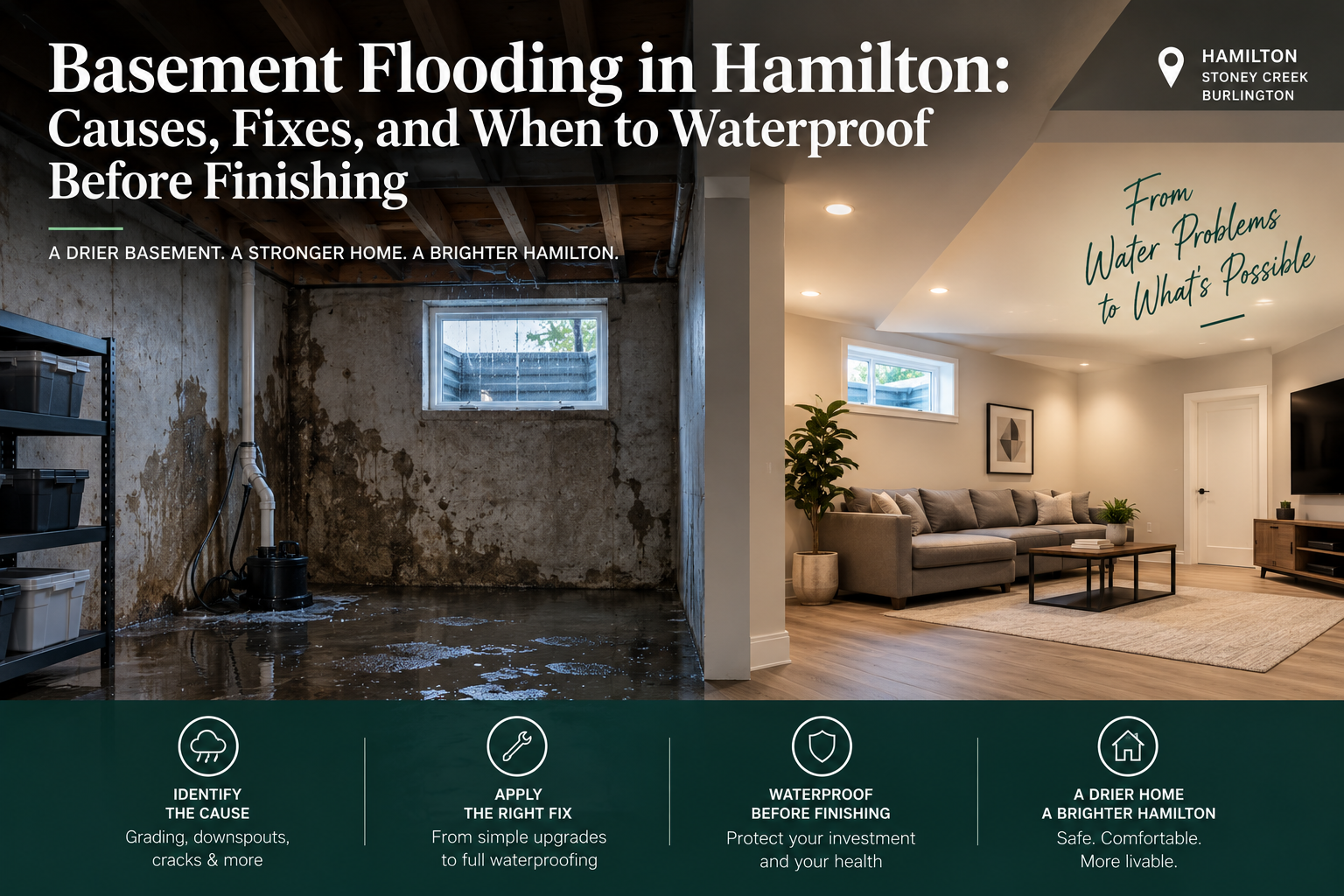
Quick answer: Basement flooding in Hamilton is most often caused by poor exterior grading, clogged or missing eavestroughs and downspouts, hydrostatic pressure pushing water through foundation cracks, or a failing or absent sump pump. Most cases can be resolved with a combination of exterior grading corrections, downspout extensions, foundation crack repair, and an interior drainage system paired with a sump pump. Any basement with a history of water intrusion should be fully waterproofed and confirmed dry before framing or finishing work begins, since covering a moisture problem with drywall only hides it temporarily.
Introduction
A wet basement is one of the most stressful problems a Hamilton homeowner can face, partly because the cause isn’t always obvious and partly because the anxiety of “what if it happens again” tends to linger long after the water is gone. Whether you’re dealing with a few inches after a heavy spring storm, a persistent musty smell that never quite clears, or damp patches that show up on the same wall every time it rains, the good news is that basement flooding almost always traces back to one of a handful of identifiable causes. This guide walks through what typically causes basement flooding in the Hamilton area, how each cause gets fixed, and why waterproofing has to happen before, not after, you finish the space.
What Causes Basement Flooding in Hamilton Homes
- Poor exterior grading. If the ground around your foundation slopes toward the house instead of away from it, every rainfall sends water directly toward your foundation walls instead of away from them.
- Clogged or short downspouts. A downspout that dumps water within a foot or two of the foundation, or one that’s clogged with leaves and debris, effectively pours water straight at the basement wall it was meant to protect.
- Foundation cracks and hydrostatic pressure. As groundwater saturates the soil around your foundation, it exerts pressure against the walls. Existing cracks, even hairline ones, become entry points under enough pressure.
- Window well drainage failure. A basement window well without proper drainage or a cover can fill with rainwater and overflow directly against the window and surrounding wall.
- Sump pump failure or absence. Homes without a sump pump, or with one that’s failed, aged out, or lost power during a storm, have no backup once water starts entering through the foundation or weeping tile system.
- Aging or damaged weeping tile. The perforated pipe that runs around the base of many foundations to direct groundwater to a sump pit can clog, crush, or deteriorate over decades, especially in older Hamilton homes.
Why Does My Basement Smell Musty After It Rains?
A musty smell that shows up specifically after rain, even without visible standing water, is one of the clearest signs of a moisture problem that hasn’t fully announced itself yet. That smell is typically mold or mildew growing somewhere you can’t see, often behind a finished wall, under flooring, or within insulation that’s absorbed moisture from a small, slow leak rather than a dramatic flood. Musty odor after rain specifically, rather than a constant smell, usually points to a grading, downspout, or foundation crack issue that only becomes active under wet conditions, which is exactly the kind of intermittent problem that’s easy to dismiss until it causes real damage.
How to Stop a Basement From Flooding: The Fix Depends on the Cause
Exterior Grading Corrections
Re-grading the soil around your foundation so it slopes away from the house, typically at least a couple of inches of drop over the first several feet, is one of the least expensive and most effective fixes available, and it’s often the first thing worth checking before assuming a bigger problem exists.
Downspout Extensions
Extending downspouts so they discharge water at least 5 to 6 feet away from the foundation, combined with keeping gutters clear of leaves, especially given Hamilton’s tree canopy in neighborhoods like Westdale and Ancaster, solves a surprising number of “mystery” basement leaks.
Foundation Crack Repair
Cracks get sealed from the inside with an injected polyurethane or epoxy, or in more significant cases, addressed from the outside with excavation and a membrane, depending on the crack’s size, location, and cause.
Interior Drainage Systems and Sump Pump Installation
For basements dealing with ongoing hydrostatic pressure rather than a single identifiable leak, an interior drainage system, sometimes called a weeping tile system, channels water to a sump pit where a sump pump removes it before it can rise into the living space. Sump pump installation as part of a basement renovation is one of the most valuable additions a homeowner can make, particularly when paired with a battery backup system that keeps the pump running during a power outage, which is exactly when storms tend to hit hardest.
Exterior Waterproofing Membranes
For chronic, severe moisture issues, excavating around the foundation to install a proper waterproofing membrane and new weeping tile is the most thorough fix available, though it’s also the most invasive and typically reserved for basements where interior measures alone haven’t solved the problem.
Basement Waterproofing Before Finishing: Why the Order Matters
This is the step that gets skipped most often, and it’s the single most expensive mistake a homeowner can make when finishing a basement. Framing, insulating, and drywalling over a basement with an unresolved moisture issue doesn’t fix anything. It just hides the problem behind materials that will absorb and hold that moisture, creating ideal conditions for mold growth that often isn’t discovered until it’s already spread significantly, sometimes not until a musty smell forces a homeowner to open the wall back up. Any basement with a documented history of water intrusion, visible efflorescence on the foundation walls, or a persistent damp smell should be fully assessed and waterproofed, then monitored through at least one full rainy season if possible, before any finishing work begins.
Signs Your Basement Needs Waterproofing Before You Finish It
- Visible white, chalky staining on foundation walls, known as efflorescence, which indicates water has been moving through the concrete.
- A musty smell that’s noticeably stronger after rain or in humid summer months.
- Any past instance of standing water, even a small amount.
- Cracks in the foundation wall, particularly horizontal cracks, which can indicate more serious structural pressure than vertical cracks.
- A sump pump that runs constantly, runs rarely but the pit fills quickly when it does, or has no battery backup.
FAQ
How do I stop my basement from flooding? Basement flooding is usually stopped by correcting exterior grading so water slopes away from the foundation, extending downspouts away from the house, repairing foundation cracks, and installing an interior drainage system with a sump pump for ongoing groundwater pressure. The right combination depends on the specific cause, which a contractor can typically diagnose during an on-site assessment.
Should I waterproof my basement before finishing it? Yes. Any basement with a history of water intrusion, visible efflorescence, or a musty smell should be fully waterproofed and confirmed dry, ideally through a full rainy season, before framing or drywall goes up. Finishing over an unresolved moisture problem hides it temporarily while allowing mold to develop out of sight.
Why does my basement smell musty after it rains, even without visible water? A rain-triggered musty smell usually indicates moisture is entering the space intermittently, often through a foundation crack, poor grading, or a downspout discharging too close to the house, and is being absorbed by materials like drywall or insulation rather than pooling visibly. This is a strong early warning sign worth investigating before it becomes a larger mold issue.
Do I need a sump pump if I’m finishing my basement? A sump pump is strongly recommended for any finished basement, particularly if there’s any history of groundwater pressure or past dampness. Pairing it with a battery backup system ensures it keeps working during a power outage, which is often when storms and flooding risk are at their highest.
Dealing with a wet, musty, or previously flooded basement in Hamilton, Stoney Creek, or Burlington? RWF Custom Contracting diagnoses the real cause before recommending any fix, and handles waterproofing correctly before any finishing work begins. Call 647-703-3528 for a free assessment, or request your free quote at rwfcustomcontracting.com/contact-us.