
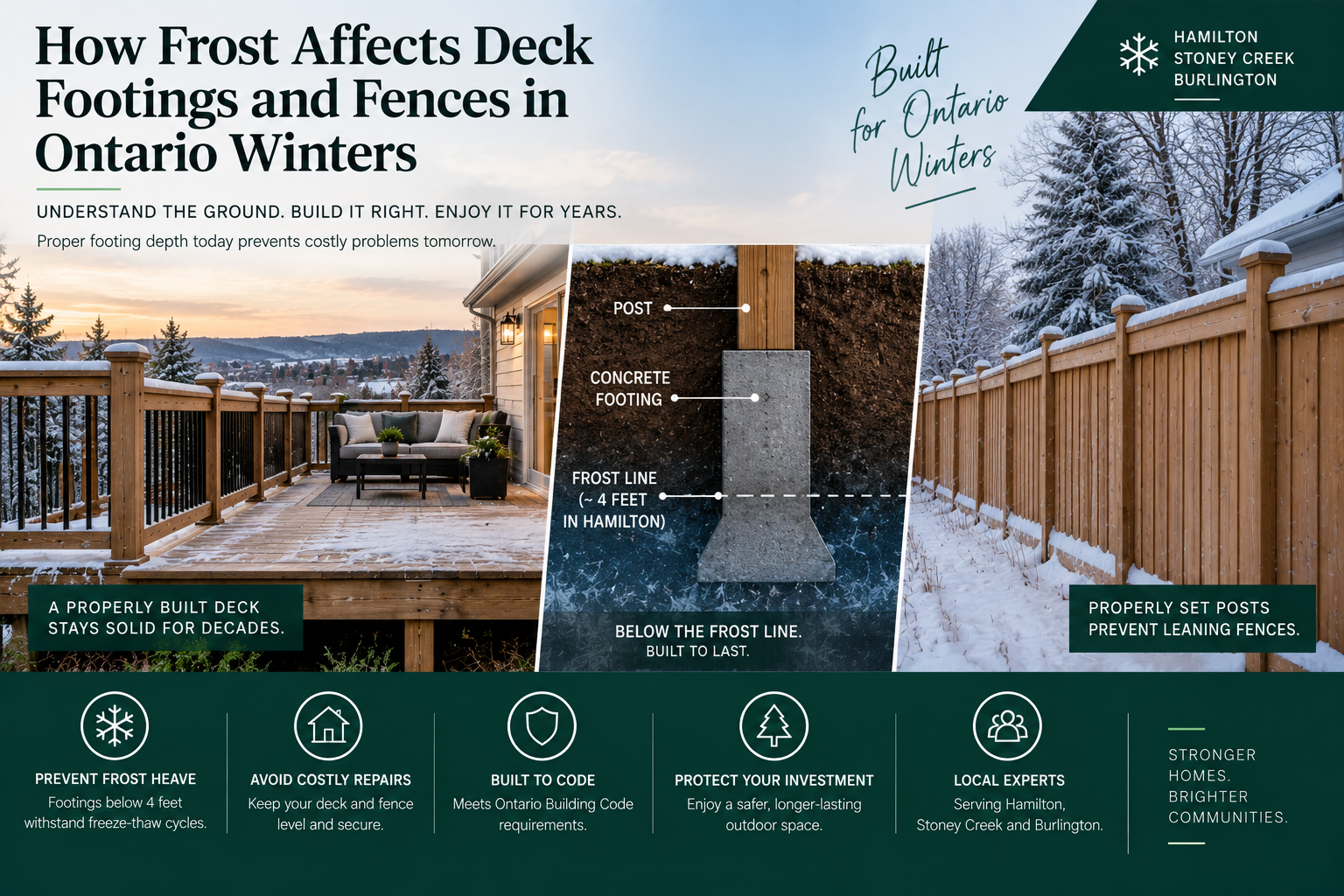
Quick answer: Frost affects deck footings and fence posts through a process called frost heave, where water in the surrounding soil freezes, expands, and pushes upward against anything embedded in the ground. In the Hamilton area, the frost line, the depth below which the ground doesn’t freeze, sits at approximately 4 feet. Footings and posts set above this depth are at risk of being gradually pushed upward over successive winters, leading to a deck that becomes wobbly or uneven, or a fence that starts to lean.
Introduction
Every winter, Ontario’s ground goes through a freeze-thaw cycle that most homeowners never think about, right up until it’s the reason their deck starts feeling wobbly or their fence begins to lean a few years after installation. The culprit is almost always frost heave, a genuinely simple physical process that has an outsized effect on anything built into the ground without accounting for it properly. Understanding how frost heave actually works explains why footing depth is one of the most important, and most invisible, details in any deck or fence project across Hamilton, Stoney Creek, and Burlington.
What Is Frost Heave, Exactly?
Frost heave happens because water expands by roughly 9 percent when it freezes. When moisture in the soil around a footing or post freezes, that expansion exerts significant upward pressure. If a footing is set below the depth where the ground actually freezes, the frost forms below and around it without lifting it. If a footing is set too shallow, sitting within the zone that freezes each winter, the expanding, freezing soil beneath and around it pushes the footing upward, sometimes by a fraction of an inch in a single winter. That might sound minor, but the effect compounds. Each freeze-thaw cycle can shift the footing slightly further, and over several winters, a footing that started level and secure can end up noticeably raised and tilted.
What Is the Frost Line Depth in Hamilton, Ontario?
The frost line in the Hamilton area sits at approximately 4 feet below grade, though this can vary somewhat depending on soil type, drainage, and the specific winter’s severity. This depth is why the Ontario Building Code and local municipal requirements specify a minimum footing depth for structures like decks, and why a contractor who properly digs and pours footings to this depth is protecting your investment for decades, not just meeting a bureaucratic requirement.
Why Deck Footings Need to Go Below the Frost Line
A deck attached to a house creates a specific structural risk if its footings aren’t set correctly. As footings on the outer edge of the deck heave upward from frost while the ledger board attachment at the house stays fixed in place, the entire deck structure can become uneven, developing a slope, gaps, or a wobble that gets progressively worse each spring. In more severe cases, uneven heaving between different footings on the same deck can put stress on the framing itself, leading to structural issues well beyond a cosmetic wobble. This is precisely why footing depth is one of the first things worth asking a deck contractor about, and why a contractor confident in their work will explain their footing method without hesitation.
How Frost Affects Fence Posts
Fence posts face the same physical process as deck footings, though the consequences tend to show up differently since a fence carries far less structural load than a deck. A fence post set above the frost line, or one that isn’t set in a concrete footing wide enough to resist the lateral pressure of freezing, expanding soil, will gradually shift and lean as successive winters heave it upward and sideways. This is the most common reason a fence that looked perfectly straight its first summer starts visibly leaning by its third or fourth winter. A properly installed fence post in the Hamilton area should generally be set to a depth of around 3 to 4 feet, below the frost line, with a concrete footing sized appropriately for the post and fence height.
Signs Frost Heave Has Already Affected Your Deck or Fence
- A deck that feels progressively more wobbly each spring, particularly after a harsh winter.
- Visible gaps opening between deck boards or between the deck and the house that weren’t there when it was built.
- A fence that leans more noticeably each year, especially if the lean is consistent along one section rather than random.
- A deck or fence post that appears higher out of the ground than it did in previous years.
How Frost-Resistant Footings Are Properly Built
A properly built footing starts with a hole dug to the full required depth below the frost line, not just deep enough to look adequate. Concrete is then poured to create a solid base, often with a footing that widens at the bottom to provide additional resistance against upward pressure. For deck posts specifically, a post base connector is typically used to keep the wood post itself out of direct ground contact, reducing rot risk in addition to providing a secure structural connection. Getting this step right is invisible once the deck or fence is finished, which is exactly why it’s worth confirming with a contractor before construction begins rather than trying to diagnose a problem after the fact.
Deck Railing Code Compliance in Ontario
While frost heave is primarily a footing concern, it’s worth mentioning alongside deck construction because the same project that gets footings right should also meet Ontario Building Code requirements for railings, including minimum guard height for decks above a certain height off grade and a maximum gap between balusters. A contractor who takes footing depth seriously is generally the same contractor who takes railing code compliance seriously, since both reflect an attention to detail that goes beyond just making the structure look finished on day one.
FAQ
How does frost affect deck footings? Frost affects deck footings through frost heave, a process where freezing water in the soil expands and pushes upward against anything embedded above the frost line. Footings set too shallow can be gradually pushed upward over successive winters, leading to an uneven or wobbly deck.
What is the frost line depth in Hamilton, Ontario? The frost line in the Hamilton area sits at approximately 4 feet below grade, though this can vary somewhat with soil type and winter severity. This is the minimum depth footings and fence posts should be set to avoid frost heave damage over time.
Why do deck footings need to go below the frost line? Footings set below the frost line sit beneath the zone of soil that freezes and expands each winter, so they aren’t affected by the upward pressure of frost heave. Footings set above that depth are at risk of shifting gradually over multiple winters, which can lead to an uneven or unstable deck.
Why does my fence lean even though it was installed correctly a few years ago? A leaning fence is usually caused by posts that weren’t originally set deep enough below the frost line, or weren’t set in an adequately sized concrete footing. Ontario’s freeze-thaw winters gradually shift under-set posts each year, and the lean tends to become more noticeable over time.
Building a deck or fence in Hamilton, Stoney Creek, or Burlington that actually holds up through Ontario winters starts with the footings you can’t see. RWF Custom Contracting sets every footing below the frost line, every time. Call 647-703-3528 for a free quote, or request your free consultation at rwfcustomcontracting.com/contact-us.