
Last Updated: November 22, 2026
Quick Summary
Choose an island countertop by matching the material to how the island is actually used, not by color alone. Map prep, heat and social zones first, then pick a surface that survives those jobs, such as quartz for low fuss or granite for heat tolerance. Mixed-material layouts often solve multi-use islands better than one surface.
- Natural stone offers unique looks and heat tolerance but most stone needs periodic sealing.
- Quartz resists stains without sealing and suits busy households, though extreme heat can scorch it.
- Butcher block is best as a prep section, not a full surface next to a sink.
- Plan seam location and slab yield before fabrication, since waterfall edges and cutouts consume material.
- Lifecycle cost includes fabrication, support framing, maintenance and repair, not just the slab price.
Table of Contents
- Start With How the Island Will Actually Be Used
- Kitchen Countertop Materials Comparison for Island Applications
- Quartz vs Granite Countertops: Which Belongs on Your Island
- Kitchen Island Countertop Ideas That Solve Real Layout Problems
- Low-Maintenance Kitchen Countertops for Busy Households
- Island Dimensions, Seams, Slab Yield and Structural Support
- Lifecycle Cost, Repairability and Sourcing
- Book a Countertop Consultation with RWF Custom Contracting
- Frequently Asked Questions
Start With How the Island Will Actually Be Used
Most homeowners shop for an island countertop the way they’d shop for a sofa: they fall for a color and a finish, then discover the practical problems later. Learning how to choose kitchen island countertop materials works better in reverse. Decide what the island has to do first, then pick the material that survives that job.
An island countertop is the horizontal work surface that caps your island base, and on most islands it takes more punishment than any other counter in the house. It’s where people chop, serve, lean, spill coffee, and park a hot pan. The material question is really a behavior question.
Map Your Island Use Zones Before You Shop
Picture the island on a busy weekday evening. Someone’s chopping vegetables at one end. Someone else is doing homework at the other. A pot of pasta is draining in the sink, and a hot baking sheet is looking for a landing spot.
That picture tells you more about material choice than any showroom display. Sketch three zones on paper:
- Prep zone: where knives, cutting boards and raw ingredients live. Prioritize scratch resistance and a surface you can sanitize.
- Heat zone: next to the range or oven. This is where heat resistance matters most.
- Social or landing zone: the overhang where people sit, eat and set down drinks. Prioritize stain resistance and comfort on forearms.
If your island is doing all three jobs, a single material may not be the answer. Mixed-material layouts, where a butcher block prep section sits beside a stone or quartz top, solve this better than any one surface can. Before you commit to a countertop, it’s worth confirming an island is even the right call for your space and budget: Is a Kitchen Island Worth the Cost? A 2026 Guide.
Kitchen Countertop Materials Comparison for Island Applications
Here’s the short version: natural stone gives you unique looks and strong heat tolerance but needs sealing and care. Engineered quartz gives you low maintenance and consistent color. Wood, laminate, stainless steel and concrete each solve a specific problem well and fail at others. The right pick depends on which trade-offs you can live with for the next fifteen years.
| Material | Best For | Watch Out For | Maintenance Level |
|---|---|---|---|
| Granite | Heat tolerance, unique pattern | Needs periodic sealing | Medium |
| Quartzite | Hard, stone look | Pricier, still needs sealing | Medium |
| Marble | Baking, classic look | Etches and stains easily | High |
| Soapstone | Heat, patina lovers | Scratches, darkens over time | Low-medium |
| Quartz | Busy families, low fuss | Can scorch under extreme heat | Low |
| Porcelain | Slim profiles, stain resistance | Chips at edges if struck hard | Low |
| Butcher block | Chopping, warmth | Needs oiling, can warp near sinks | High |
| Laminate | Tight budgets | Heat and moisture damage | Low |
| Stainless steel | Serious cooks | Scratches, shows fingerprints | Low |
| Concrete | Custom shapes | Cracks, needs sealing | Medium-high |
Natural Stone: Granite, Quartzite, Marble, Soapstone and Limestone
Natural stone countertops are cut from quarried blocks, so every slab carries its own pattern and no two islands look identical. Granite handles heat well and resists scratches, making it a solid island choice for cooks who set down hot pans without thinking. Quartzite is harder still and looks like marble without the fragility. Marble is the beautiful problem child: it etches when lemon juice or vinegar sits on it, and it stains if red wine lingers. Soapstone is softer and develops a patina many homeowners love, but it scratches and darkens over time. Limestone is the most porous of the group and needs the most sealing.
The trade-off with natural stone is maintenance, since most stone needs periodic sealing.
Engineered Stone, Porcelain and Solid Surface
Engineered stone, usually sold as quartz, mixes crushed stone with resin binders. The result is a non-porous surface that resists stains without sealing, comes in consistent colors, and stands up well to daily family life. Porcelain slabs are thin, stain-resistant and heat-tolerant, though edges can chip if something heavy hits them. Solid surface materials like Corian are repairable, because scratches and burns can be sanded out, and can be shaped seamlessly around sinks.
For islands specifically, quartz is a common choice for busy households. It handles the daily grind with minimal fuss, though you still shouldn’t put a screaming-hot pan directly on it.
Butcher Block, Laminate, Stainless Steel and Concrete
Butcher block brings warmth and a knife-friendly surface, and it’s the best choice if you actually chop on the island. It needs regular oiling and doesn’t love standing water near the sink. Laminate is the budget-friendly option and has improved a lot, but heat and moisture are its weak points. Stainless steel is what professional kitchens use: hygienic, heat-proof and practically indestructible, though it scratches and shows every fingerprint. Concrete offers custom shapes and a raw look, but it cracks, stains and needs sealing.
A common mistake is choosing butcher block for the whole island because it looks warm in photos. It’s brilliant as a prep section and a headache as a full surface next to a sink.
Quartz vs Granite Countertops: Which Belongs on Your Island
For many busy households, quartz is an easier fit on an island because it resists stains without sealing and needs less day-to-day care. Granite may suit you better if heat tolerance and a one-of-a-kind pattern matter more than maintenance.
Granite is natural stone, so it’s porous and needs sealing to keep stains out. It handles hot pans better than quartz, which can scorch or discolor under extreme direct heat.
If you cook with high heat and love the idea of a slab nobody else owns, granite fits. If you want to wipe up spaghetti sauce and move on with your evening, quartz fits.
Kitchen Island Countertop Ideas That Solve Real Layout Problems
The best island countertop ideas start with the problem the island has to solve, not the material sample you liked on Pinterest. A narrow galley kitchen needs a different island solution than a wide open-plan space. Here’s how to match material and layout to the constraint in front of you.
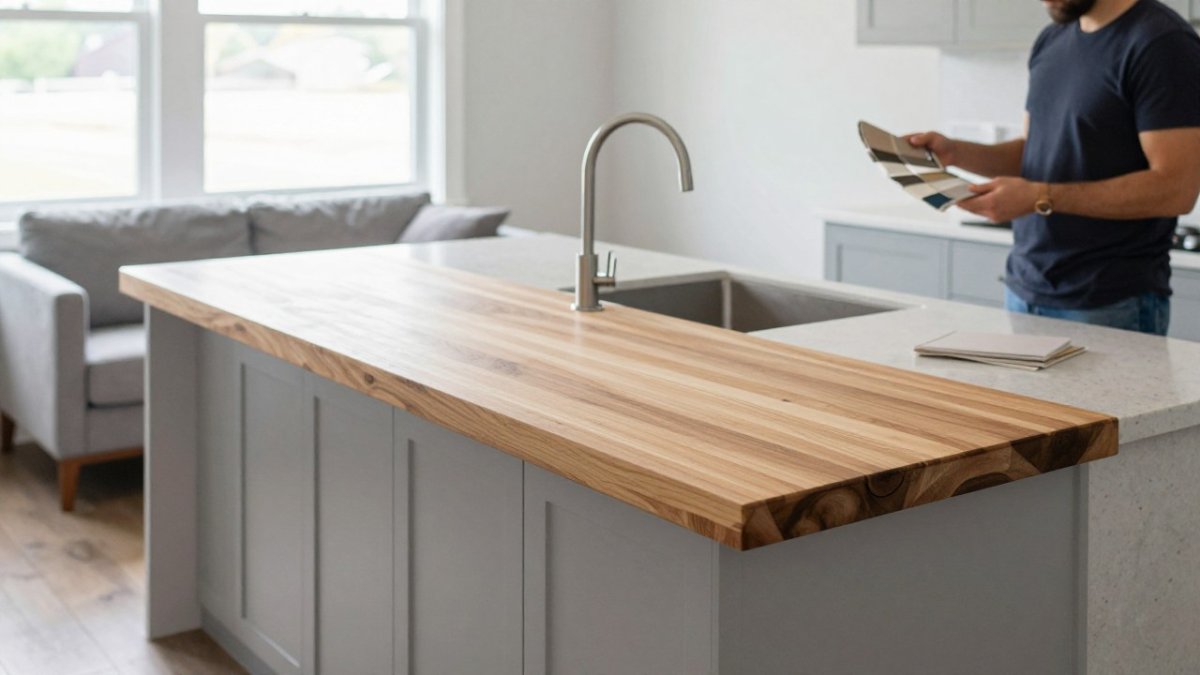
- Small or oddly shaped island: a single slab in a lighter color makes the island feel bigger. Skip busy veining that chops up a small surface.
- Island doubling as a dining table: a lower butcher block section at seating height feels warmer under elbows and takes the wear of daily meals.
- Island beside the range: run a heat-tolerant stone or porcelain section near the cooking zone and a softer material at the seating overhang.
- Waterfall edge design: the countertop runs down the side of the island to the floor, which looks striking but uses more slab, so plan the yield carefully.
- Sink in the island: solid surface and quartz handle the moisture around a sink better than wood.
For a tricky or compact space, the full kitchen renovation guide walks through how layout, storage and materials fit together across the whole project.
Low-Maintenance Kitchen Countertops for Busy Households
If you want a countertop you can wipe and forget, quartz, porcelain and solid surface are the low-maintenance leaders. All three resist stains without annual sealing, which matters on an island that sees three meals a day plus homework and coffee.
Solid surface is repairable, since scratches and burns can generally be sanded out. Porcelain shrugs off stains and heat but needs care at the edges. Quartz is the middle ground most families land on.
What most guides miss is that “low-maintenance” isn’t just about sealing. It’s about how the material handles the specific messes your household makes. A family that bakes a lot will notice flour and butter on a porous stone.
Island Dimensions, Seams, Slab Yield and Structural Support
An island countertop is limited by the size of the slab it’s cut from, and that single fact drives more design decisions than most homeowners expect.
Slab yield is the quiet budget killer.
Dimensions matter too. Seating overhangs typically need enough depth to sit comfortably, and the overhang has to be supported, often with corbels or a steel frame. Islands are heavy, and a stone top adds serious weight to the base.
Edge profiles also affect durability. A sharp square edge looks modern but chips more easily than a slight roundover. On an island where kids and hips meet the edge constantly, a softened profile is the practical choice.
Lifecycle Cost, Repairability and Sourcing
The sticker price of a countertop is only the first number. Lifecycle cost includes sealing, cleaning products, repairs, and how soon the surface needs replacing.
Maintenance cost varies. Natural stone typically needs periodic resealing, plus stone-specific cleaners. Butcher block needs regular oiling and careful management around the sink. Quartz, porcelain, and solid surface need little beyond routine cleaning, which lowers the ongoing cost even when the purchase price is higher.
Repairability separates materials sharply. Solid surface and butcher block can be sanded and refinished, so a scratch or scorch can be removed rather than lived with. Natural stone can sometimes be re-polished by a specialist, though the result depends on the stone and the damage.
Sourcing matters for both budget and lead time. Hidden costs in a kitchen renovation, from fabrication to support framing, are exactly the kind of thing that blows a budget, so it pays to plan for the hidden costs before you fall in love with a slab.
Book a Countertop Consultation with RWF Custom Contracting
Choosing an island countertop comes down to matching material to how your household actually lives, then getting the fabrication, seams and support right. That second part is where projects go wrong, and it’s where a single team managing the whole job makes the difference.
If you’re also weighing cabinet work alongside new counters, our guide to kitchen cabinets refacing versus replacing covers that decision. When you’re ready to talk materials, dimensions and support for your island, get in touch with our team to book a consultation.
The hardest part of this decision isn’t picking a pretty slab. It’s getting the seams, support and fabrication right so the island performs for the next twenty years.
Frequently Asked Questions
What is the best material for a kitchen island countertop?
There is no single best material because the right island countertop depends on how you use the space. Quartz and granite suit heavy food prep and resist stains well, while butcher block works for baking and slicing but needs oiling. Porcelain handles heat and scratches, and solid surface allows seamless repairs. Match the material to your cooking style, cleaning habits and budget rather than chasing a universal winner.
Is quartz or granite better for a kitchen island?
Quartz is non-porous, so it resists stains and needs no sealing, which makes it a low-maintenance choice for busy islands. Granite is natural stone with unique patterning and strong heat resistance but requires periodic sealing. For an island used daily for meals and prep, quartz usually wins on upkeep. Granite appeals if you want one-of-a-kind looks and don’t mind sealing every year or two.
What countertop material is easiest to maintain?
Quartz and solid surface are the easiest to maintain because they are non-porous and wipe clean with mild soap and water. Porcelain is also simple to clean and highly scratch-resistant. Materials like marble, limestone and butcher block demand more attention, including sealing, oiling or careful stain management. If you want to skip routine sealing, engineered stone is the practical pick.
Do kitchen island countertops need to match the perimeter countertops?
No, they do not have to match. Many designs mix materials to define zones, such as quartz on the island and butcher block or laminate on the perimeter. Matching creates a unified look, while contrasting materials can make the island a focal point. Consider slab yield and seams when mixing, and confirm that the structural support suits the heavier material you choose.
