
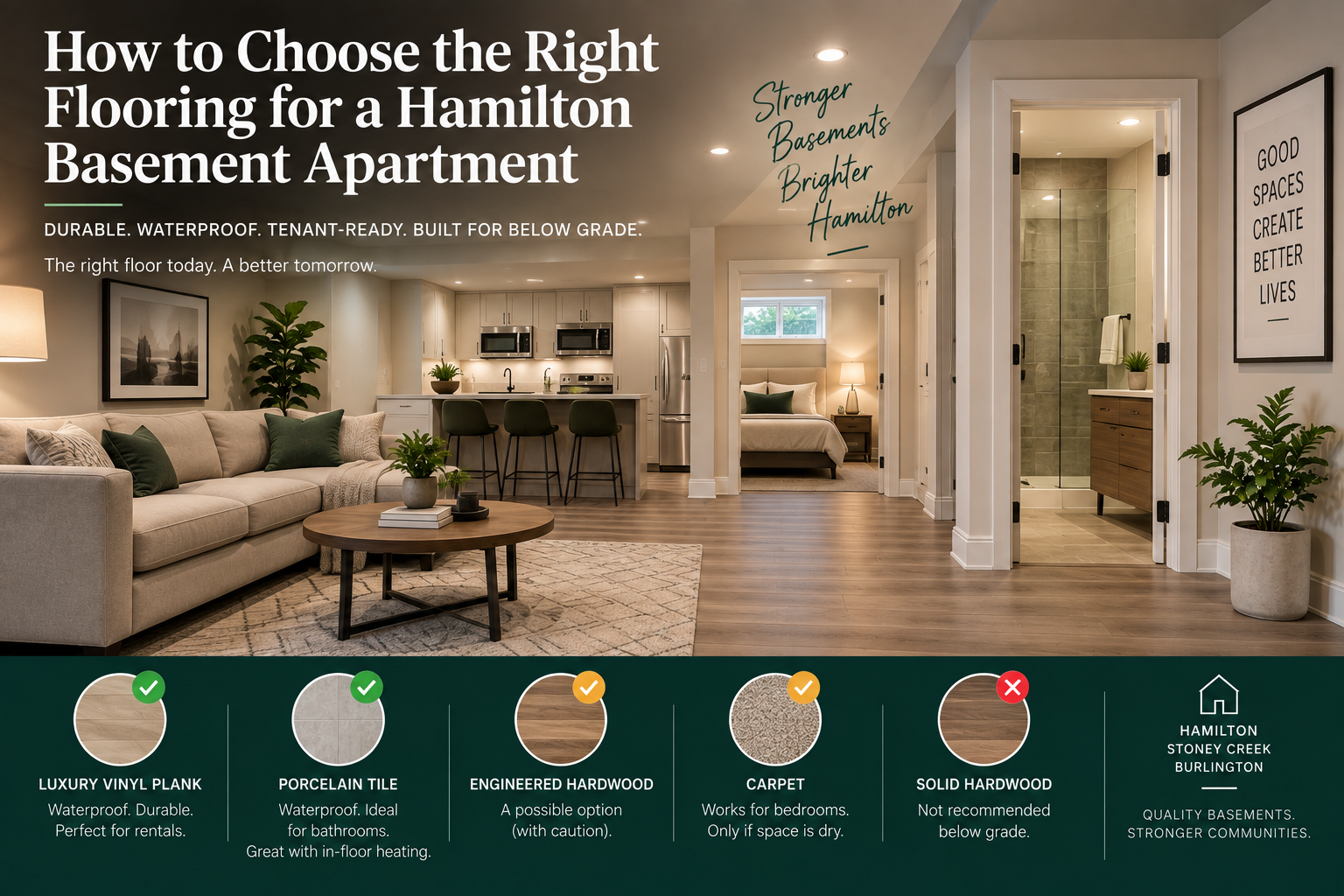
Quick answer: Luxury vinyl plank is generally the best flooring choice for a Hamilton basement apartment, since it’s fully waterproof, holds up well to below-grade temperature swings, and stands up to the wear of tenant use. Porcelain tile, often paired with in-floor heating, is the strongest choice for basement bathrooms specifically. Solid hardwood should be avoided below grade entirely, since basement moisture levels will eventually damage it regardless of how well the rest of the space is waterproofed.
Introduction
Flooring is one of the last decisions made in a basement apartment build, but it’s also one of the decisions with the least room for error. A basement, even a well-waterproofed one, sits below grade and experiences different humidity and temperature conditions than the rest of the house, which rules out some flooring materials that would work perfectly well upstairs. For a legal basement apartment specifically, where the space needs to hold up to tenant use over years rather than occasional homeowner use, the flooring decision matters even more. This guide walks through the flooring options that actually work below grade, and which ones to avoid regardless of how good a deal looks.
Why Basement Flooring Decisions Are Different
Even a properly waterproofed basement experiences more humidity fluctuation than a main or upper floor, simply because it’s surrounded by earth and concrete rather than open air. Materials that expand and contract with moisture, like solid hardwood, are particularly vulnerable to this environment, while materials engineered to be fully waterproof or highly moisture-resistant hold up far better over the life of the space. For a basement being converted into a legal rental apartment, there’s an added layer of consideration: the flooring needs to withstand years of tenant turnover, moving furniture, and day-to-day wear without needing frequent replacement.
Best Flooring Options for a Basement Apartment
Luxury Vinyl Plank
Luxury vinyl plank has become the default recommendation for basement apartment flooring in Hamilton, and for good reason. It’s fully waterproof at the surface level, handles the temperature swings of a below-grade space without warping, and comes in a wide range of finishes that convincingly mimic hardwood or stone at a fraction of the cost and risk. It also holds up well to the wear and tear of tenant use, which matters when the flooring needs to last through multiple tenancies rather than one homeowner’s careful daily habits.
Porcelain or Ceramic Tile
Tile remains the strongest option for basement bathrooms and entryways specifically, where water exposure is highest. It’s completely impervious to moisture at the surface, extremely durable, and, when paired with heated tile flooring, solves the common complaint about cold basement floors in a Hamilton winter. Heated tile flooring bathroom installation adds a modest cost during construction but is consistently one of the upgrades tenants and homeowners alike mention appreciating most.
Engineered Hardwood (With Caution)
Engineered hardwood, which has a real wood veneer over a plywood or composite core, performs better below grade than solid hardwood because it’s more dimensionally stable, but it’s still not fully waterproof and isn’t the first choice for a basement with any history of moisture concerns. If a homeowner specifically wants the look of hardwood in a basement living area with a confirmed dry, well-ventilated environment, engineered hardwood is a reasonable middle-ground choice, though luxury vinyl plank remains the more forgiving option for a rental unit.
Carpet Tile or Low-Pile Carpet
Carpet can work in a basement bedroom or living area, particularly for warmth and sound absorption between floors, but it should be paired with a moisture-resistant subfloor and is generally not recommended in a basement with any history of dampness, since carpet absorbs and holds moisture far more readily than hard flooring.
What to Avoid Entirely Below Grade
Solid hardwood should be avoided in a basement application without exception. Even in a basement that tests as dry today, solid hardwood is dimensionally unstable enough that normal seasonal humidity swings in a below-grade space will eventually cause cupping, gapping, or warping, regardless of how well the rest of the space was waterproofed. Laminate flooring, while inexpensive, is also a poor fit for basements prone to any moisture, since most laminate products swell permanently and irreversibly if exposed to standing water, even briefly.
Best Flooring for Basements Prone to Moisture
If your basement has any history of dampness, even minor, luxury vinyl plank with a fully waterproof core is the safest choice available, since it’s engineered specifically to tolerate moisture exposure at the seams and surface without swelling or delaminating. That said, flooring choice is never a substitute for addressing the actual source of the moisture. If your basement has a documented history of water intrusion, that needs to be resolved through proper waterproofing before any flooring goes down, not compensated for with a more moisture-tolerant material layered on top of an unresolved problem.
Flooring Comparison for Basement Apartments
Flooring Type | Moisture Resistance | Durability for Rentals | Comfort Underfoot | Relative Cost |
Luxury vinyl plank | Excellent, fully waterproof | Excellent | Good, slightly warmer than tile | Low to moderate |
Porcelain or ceramic tile | Excellent | Excellent | Cold unless heated | Moderate to high |
Engineered hardwood | Moderate | Good | Good | Moderate to high |
Carpet or carpet tile | Poor | Fair | Excellent | Low to moderate |
Solid hardwood | Poor, not recommended | N/A | Good | High |
Subfloor Considerations Before Flooring Goes Down
Regardless of which flooring material is chosen, a proper subfloor system matters just as much below grade. Many basement flooring installations start with a subfloor product that creates a small air gap between the concrete slab and the finished floor, allowing any residual moisture in the slab to dissipate rather than getting trapped directly beneath the new flooring. Skipping this step to save a small amount on materials is one of the more common corner-cutting mistakes that leads to flooring problems within the first few years, even when the flooring material itself was a good choice.
FAQ
What is the best flooring for a basement apartment? Luxury vinyl plank is generally the best flooring for a basement apartment, since it’s fully waterproof, handles the temperature and humidity swings of a below-grade space, and holds up well to the wear of tenant use over multiple tenancies.
What is the best flooring for basements prone to moisture? For basements with any history of dampness, luxury vinyl plank with a fully waterproof core is the safest flooring choice. It should always be paired with proper waterproofing of the underlying moisture source rather than used as a substitute for fixing the actual problem.
Is heated tile flooring worth it in a basement bathroom? Most homeowners and tenants who’ve had it say yes. Heated tile flooring adds a modest cost during a bathroom renovation but directly solves the common complaint of cold basement floors during Hamilton winters, and it’s one of the upgrades that gets mentioned most often as worth the investment.
Can I use hardwood flooring in my basement? Solid hardwood is not recommended in a basement under any circumstances, since normal humidity fluctuations below grade will eventually cause it to cup, gap, or warp. Engineered hardwood performs somewhat better but still isn’t as forgiving as luxury vinyl plank for a basement application.
Planning flooring for a basement apartment, rental suite, or living space in Hamilton, Stoney Creek, or Burlington? RWF Custom Contracting installs flooring built to handle below-grade conditions, whether you’re finishing a basement for your family or building out a legal rental unit. Call 647-703-3528 for a free quote, or request your free assessment at rwfcustomcontracting.com/contact-us.