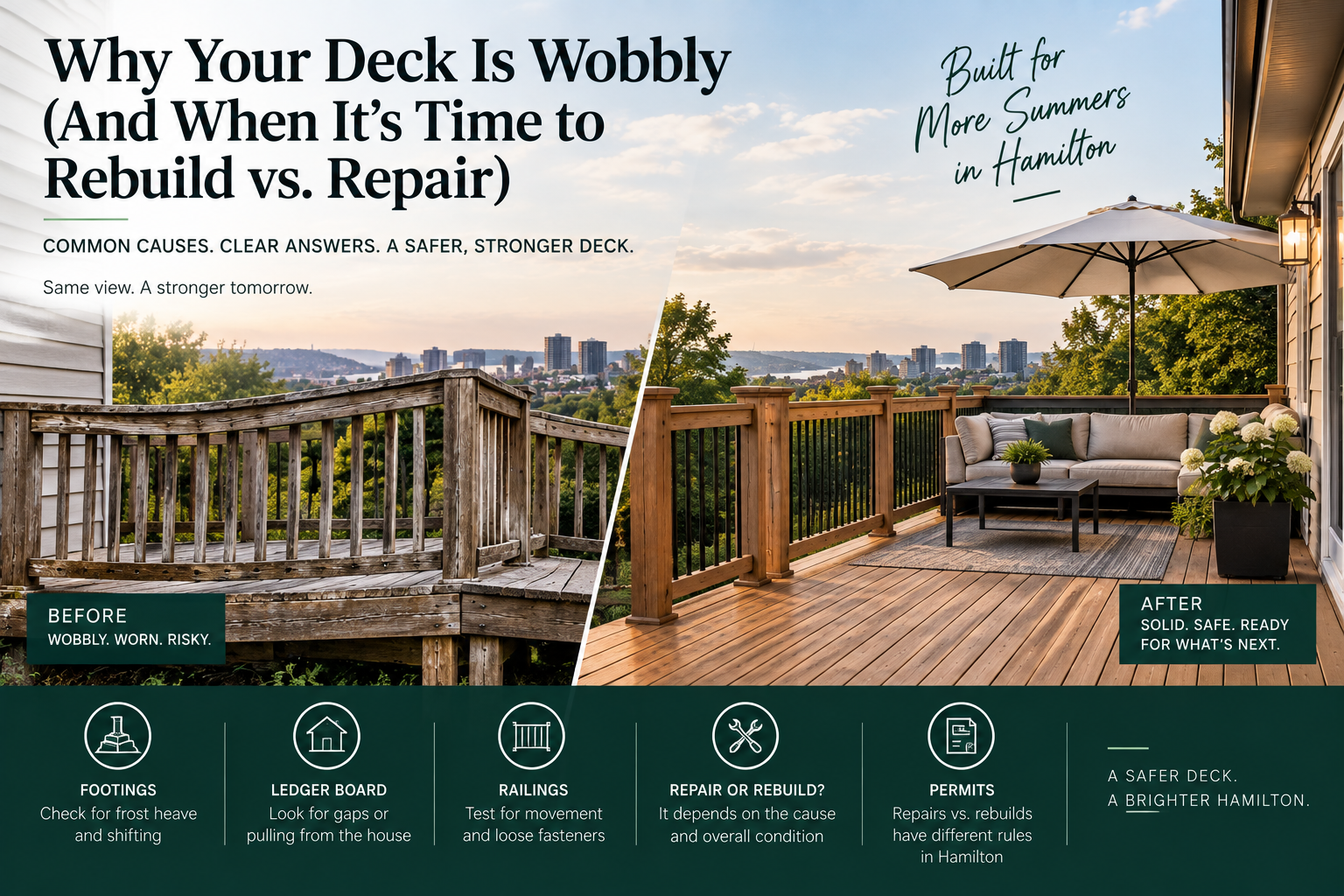
Quick answer: A wobbly deck is almost always caused by one of three things: footings that weren’t set below the frost line and have shifted, a ledger board that’s pulling away from the house, or railings that have loosened over time. Footing problems usually mean a rebuild, while a loose ledger board or railing can often be repaired if the rest of the structure is sound. The only way to know which one you’re dealing with is a physical inspection starting at the footings and working up.
Introduction
A deck that felt solid the summer it was built and now sways a little when you walk across it isn’t unusual in Hamilton, especially on decks that have been through a decade or more of freeze-thaw winters. The instinct is often to assume the whole structure needs replacing, but that’s not always true. A wobbly deck has a handful of common, diagnosable causes, and figuring out which one you’re dealing with determines whether you’re looking at a straightforward repair or a full rebuild. This guide walks through the diagnostic process from the ground up, literally, starting with the part of the deck you can’t see.
Start at the Footings: The Most Common Cause of a Wobbly Deck
If a deck feels unstable across its entire surface, not just in one localized spot, the footings are the first thing worth suspecting. Ontario’s frost line sits at approximately 4 feet in the Hamilton area, and any footing that wasn’t dug and poured below that depth is vulnerable to frost heave, where the ground freezing and expanding each winter gradually pushes the footing upward. Over several winters, this shifts the entire deck structure, often unevenly, since footings on one side of the deck may be affected more than others depending on soil conditions and drainage. A deck with a frost heave problem typically feels progressively worse each spring and may show visible gaps opening up between the deck and the house, or between deck boards that used to sit flush.
How to check: Look for any visible gap between the deck framing and the ground at the base of each post, and check whether the deck feels more unstable near specific corners versus evenly across the whole surface. If you can access the underside of the deck, a footing that has heaved will often be visibly tilted rather than sitting flat and level.
Check the Ledger Board Next
The ledger board is the horizontal board that attaches an attached deck directly to the house, and it carries a significant portion of the deck’s structural load. If fasteners have corroded, if the board wasn’t properly flashed to prevent water infiltration behind it, or if it simply wasn’t attached correctly in the first place, the ledger board can begin pulling away from the house structure. This shows up as a wobble concentrated near the house side of the deck, sometimes with a visible gap opening between the ledger board and the siding or rim joist.
How to check: Push down firmly on the deck surface close to where it meets the house and watch for any visible movement or gap at the ledger connection. A flashlight aimed into that gap, if one exists, can reveal water staining, which points to a moisture problem compounding the structural one.
Check the Railings Last
Railings that wobble independently of the deck surface itself are usually the least serious of the three common causes, though they still matter for safety. Loose railing posts typically result from fasteners that have backed out over time, wood that’s split around a lag bolt, or a post that was never anchored deeply enough into the framing below. Ontario Building Code sets specific requirements for guard height and baluster spacing on residential decks, generally requiring a minimum guard height for decks above a certain height off grade, along with a maximum gap between balusters to prevent a small child from passing through. A rebuild or repair is also the right time to confirm your existing railings actually meet current code, since older decks were sometimes built under different, less strict standards.
How to check: Grab each railing post firmly and try to rock it side to side. Any noticeable movement at the base indicates a compromised connection to the framing below.
How to Tell If Your Deck Needs Replacing vs. Repairing
Diagnosis | Likely Fix | General Scope |
Footings heaved or shifted | Full rebuild | Footings need to be re-dug below frost line; framing above is usually rebuilt at the same time |
Ledger board pulling away, framing otherwise sound | Repair | Ledger reattachment and proper flashing, without touching footings or decking |
Loose railings only, framing and footings solid | Repair | Railing posts reinforced or replaced, hardware upgraded to current code |
Deck is 20+ years old with multiple issues layered together | Full rebuild | Combined footing, framing, and material age issues usually make a rebuild more cost-effective than piecemeal repairs |
Do Deck Repairs Require a Permit?
Deck footing and permit requirements in Hamilton generally depend on the scope of work rather than the fact that it’s a “repair.” Replacing decking boards or railings without touching the structural footings or framing typically doesn’t require a new permit, since you’re not changing the structure itself. A full rebuild that involves new footings, however, is treated the same as new construction and does require a permit through the City of Hamilton, particularly for decks attached to the house or built above a certain height off grade. If you’re not sure which category your project falls into, it’s worth confirming before work starts rather than after, since unpermitted structural work can complicate a future home sale.
When a Repair Genuinely Isn't Worth It
Sometimes the math simply doesn’t favor a repair. A deck with heaved footings on one corner, a pulling ledger board, and loose railings all at once is usually a sign of a structure nearing the end of its usable life rather than three unrelated problems. In that situation, a full rebuild with properly set footings, a correctly flashed ledger board, and code-compliant railings often costs only modestly more than addressing each issue separately, while delivering a deck that’s genuinely solid rather than patched together.
FAQ
Why does my deck feel wobbly even though it’s not that old? A wobbly deck usually means the footings weren’t set below Hamilton’s frost line, roughly 4 feet deep, and have shifted from freeze-thaw cycles, or that the ledger board attaching the deck to the house has started pulling away. A contractor can typically diagnose which one it is with a physical inspection of the footings and ledger connection.
How do I tell if my deck needs replacing or just repairing? If the problem is isolated to loose railings or a pulling ledger board while the footings and main framing remain solid, a repair is often enough. If the footings themselves have heaved or shifted, a full rebuild is usually the more reliable and cost-effective fix.
Does a deck repair require a permit in Hamilton? Repairs that don’t touch the structural footings or framing, like replacing boards or railings, generally don’t require a new permit. A full rebuild involving new footings is treated as new construction and does require a permit from the City of Hamilton.
What is the Ontario Building Code requirement for deck railings? Ontario Building Code sets minimum guard height requirements for decks above a certain height off grade, along with a maximum allowable gap between balusters. A rebuild or major repair is a good opportunity to confirm your existing railings meet current code, since older decks were sometimes built to different standards.
Not sure if your Hamilton deck needs a repair or a full rebuild? RWF Custom Contracting diagnoses the actual cause, starting at the footings, before recommending any fix. Call 647-703-3528 for a free assessment, or request your free quote at rwfcustomcontracting.com/contact-us.