
Table of Contents
- Basement Finishing Cost Per Square Foot: What to Expect
- Factors That Influence Your Basement Finishing Budget
- Basement Renovation Permit Requirements and Inspection Costs
- Average Basement Finishing Timeline and Project Phases
- Hidden Costs and Contingency Planning
- Basement Finishing ROI: Recouping Your Investment
- DIY vs. Professional Finishing: True Cost Comparison
- Conclusion
- Frequently Asked Questions
Last Updated: September 28, 2026
Basement Finishing Cost Per Square Foot: What to Expect
Basement finishing costs vary depending on material quality, project scope, and complexity.
The difference between a budget-conscious approach and a high-end finish can significantly impact your total project cost. At RWF Custom Contracting, we’ve managed hundreds of basement projects across the Golden Horseshoe, and transparency about costs upfront prevents budget surprises later.
Building permits, moisture mitigation, egress windows, and structural repairs can shift your final bill significantly from initial estimates. This guide breaks down the factors that determine your basement finishing cost per square foot and helps you avoid common mistakes that leave homeowners scrambling for extra funding mid-project.
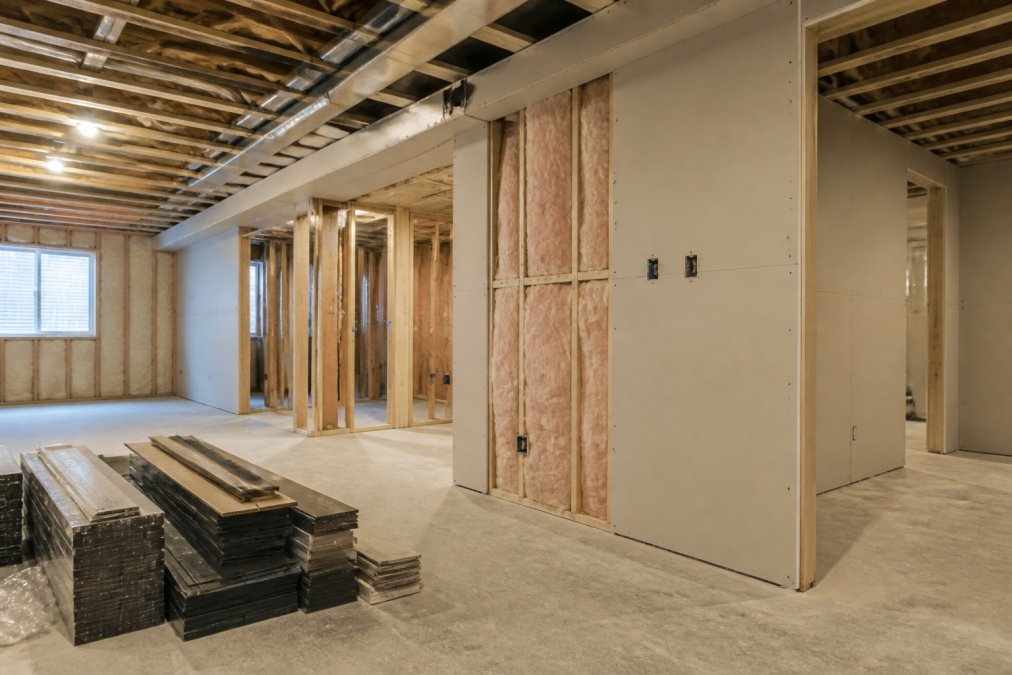
Factors That Influence Your Basement Finishing Budget
Your basement finishing cost per square foot depends on the condition of your existing basement, material quality choices, labor intensity, local building codes, floor plan complexity, and whether structural or moisture issues exist.
A basement with moisture problems, foundation cracks, or inadequate drainage requires remediation before finishing. Moisture mitigation, vapor barriers, sump pump installation, or foundation sealing, can add to the cost before finishing work begins.
Material quality levels create the widest range in per-square-foot cost. Insulation R-value, flooring options, and ceiling height all affect both cost and long-term performance.
Material Quality Levels
Budget finishes use standard drywall and basic vinyl flooring. Mid-range finishes include quality drywall, laminate or engineered hardwood, and R-15 to R-19 insulation. Custom finishes feature premium materials, hardwood or luxury vinyl plank, and R-21+ insulation.
Lighting design and ceiling treatments add to the cost depending on complexity.
Labor vs. Material Cost Allocation
Labor typically accounts for 40 to 60 percent of basement finishing cost per square foot. Simple rectangular basements require less labor than oddly shaped spaces with low ceilings, load-bearing walls, or complicated electrical and plumbing.
Electrical rough-in and plumbing require licensed professionals, increasing labor costs. RWF Custom Contracting manages all phases with a single team, eliminating coordination delays that plague multi-contractor projects.
Basement Renovation Permit Requirements and Inspection Costs
Building permits are required for basement renovations involving egress windows, electrical work, plumbing, or structural changes. Permit costs vary.
Inspection costs add to the overall project. Most projects require two inspections: rough-in and final completion.
Egress windows are mandatory in bedrooms below grade, adding to the cost per window. Code compliance prevents liability and resale risk that far outweighs permit savings.
Average Basement Finishing Timeline and Project Phases
A typical basement finishing project spans 8 to 12 weeks from permit approval to final inspection, including permit approval, structural and moisture work, rough-in utilities, insulation, drywall, finishing, and flooring.
Delays compound quickly: delayed permits add 2-4 weeks, foundation issues add 2-3 weeks. RWF Custom Contracting maintains tight scheduling by managing all phases in-house.
Hidden Costs and Contingency Planning
Hidden costs derail projects. Budget surprises include foundation repairs, asbestos abatement, unexpected plumbing or electrical rework, and structural issues discovered during demolition.
Set aside 10 to 15 percent of your total project cost for unexpected expenses. For a project, that’s a significant amount. Projects that skip this buffer often end up over budget.
Sump pump installation, vapor barrier upgrades, egress window reinforcement, electrical panel upgrades, and plumbing relocation frequently emerge mid-project as structural realities.
Financing Options for Basement Finishing Projects
Home Equity Line of Credit (HELOC): Borrow at variable rates (typically 2-4 points above prime) and draw only what you need. Ideal for uncertain scope, but rates fluctuate and work best with a clear 5-10 year timeline.
Home Equity Loan: Fixed rates (6-9%) lock in payment certainty for 5-20 years. You receive the full amount upfront, ideal if you have detailed quotes and fixed scope. Trade-off: you pay interest on the full amount immediately.
Renovation Loans: Staged funding tied to milestones (30% at permit, 40% at rough-in, 30% at completion) protects both parties. Rates run 0.5-1.5 points higher than home equity loans, but staged funding reduces risk.
Payment Milestone Structures: Reputable contractors use 25% deposit, 50% at rough-in, 25% at completion. Never pay the full amount upfront; retain leverage if quality fails.
Hidden costs and financing surprises compound when you don’t plan for them. A foundation repair discovered mid-project can become a larger problem if you’re forced to borrow at emergency rates. Build your contingency reserve and understand your financing options before breaking ground.
Common Hidden Cost Categories
Foundation and Moisture Issues: $5,000-$20,000. Cracks, seepage, or inadequate drainage discovered during demolition require professional remediation before finishing can proceed. Vapor barrier installation, sump pump upgrades, or foundation sealing add weeks and cost.
Structural Repairs: $3,000-$15,000.
Basement Finishing ROI: Recouping Your Investment
Basement finishing ROI has two dimensions: resale value and functional value. Most homeowners focus on resale, but the long-term utility savings from modern insulation and moisture control often deliver greater total ROI than the home sale itself.
Resale Value and Market ROI
In most Canadian markets, a finished basement typically returns 50 to 75 percent of its cost at resale, depending on local demand and the quality of the work. A basement renovation might add significant resale value. This varies significantly by region: markets with strong demand for additional living space (suburban areas with young families) see higher returns than markets where basements are common and less differentiated.
Energy Efficiency and Long-Term Utility Savings
This is where basement finishing delivers hidden ROI that most homeowners overlook. An unfinished basement with concrete walls and no insulation acts as a thermal drain on your home. Heat escapes through the foundation in winter; cool air leaks out in summer. Finishing with proper insulation creates measurable utility savings that compound over decades.
Total ROI Framework
Calculate your true ROI by combining three factors:
- Resale Value: 50-75% of project cost (varies by market)
- Functional Value: Daily use, rental income, or space value (immediate, non-financial)
- Energy and Maintenance Savings: $300-$600 annually from insulation and moisture control (compounds over 20+ years)
A basement project might deliver:
- Significant resale value
- Substantial cumulative heating savings over 20 years
- Avoided water damage and mold remediation
- Immediate functional value: family use, rental income, or livable space
Total ROI often exceeds 100 percent when you account for all three dimensions, especially if you stay in the home for 10+ years and capture the long-term utility savings.
DIY vs. Professional Finishing: True Cost Comparison
DIY basement finishing appeals to budget-conscious homeowners, but the actual cost comparison is misleading. Material costs for a DIY project run 30 to 40 percent lower than professional work, but labor costs shift entirely to you, and your time has value.
If you’re considering DIY finishing, limit it to non-structural work: painting, trim installation, or flooring in spaces where electrical and plumbing are already complete. Hire professionals for rough-in phases and code-dependent work.
Conclusion
Basement finishing cost per square foot varies depending on material quality, project complexity, and local labor rates. The real cost emerges when you account for permits, inspections, moisture mitigation, and the contingency reserves that prevent budget disasters. RWF Custom Contracting has managed basement finishing projects across Hamilton, Burlington, and Stoney Creek that deliver code-compliant results on time and on budget.
| Cost Factor | Budget Approach | Mid-Range Approach | Premium Approach |
|---|---|---|---|
| Flooring | $3-5/sq ft | $6-8/sq ft | $10-12/sq ft |
| Insulation | $1-2/sq ft | $2-3/sq ft | $3-4/sq ft |
| Drywall & Finishing | $2-3/sq ft | $3-4/sq ft | $5-6/sq ft |
| Electrical/Plumbing | $4-6/sq ft | $6-8/sq ft | $8-10/sq ft |
| Labor (per sq ft) | $15-25/sq ft | $25-40/sq ft | $40-60/sq ft |
| Total Per Square Foot | $25-41/sq ft | $42-63/sq ft | $66-92/sq ft |
Frequently Asked Questions
What is the average cost per square foot to finish a basement in 2026?
Basement finishing costs vary based on material quality, structural condition, and local labor rates. Basic finishes start at the lower end, while custom finishes with premium materials and specialized features cost significantly more per square foot. Factors like egress windows, HVAC ductwork, moisture mitigation, and building code compliance also affect the final price. Request a detailed quote from a local contractor who understands your specific basement’s condition and your project scope.
Does finishing a basement increase home value and provide good ROI?
Yes, basement finishing typically improves home market value and can offer strong return on investment, especially when the space is functional and code-compliant. A finished basement adds usable living space, increases resale appeal, and can support rental income if converted into a legal duplex or rental unit. However, ROI depends on the quality of finishes, adherence to building codes, and local real estate demand. Work with a contractor who understands local building codes to maximize resale value.
What are the main factors that influence basement finishing costs?
Key cost drivers include basement size and square footage, structural integrity and foundation repairs needed, moisture mitigation and sump pump installation, material quality levels (basic, mid-range, or custom finishes), labor costs and contractor expertise, building permits and inspection fees, electrical rough-in and HVAC ductwork installation, and plumbing fixture placement. Egress windows for legal bedrooms, ceiling height modifications, and custom millwork also significantly impact total project cost. A transparent contractor will break down each component in writing.
How long does a typical basement finishing project take?
Timeline varies based on basement size, project scope, and complexity. Basic finishing projects may take 4-8 weeks, while larger renovations with structural work, moisture remediation, or custom finishes can extend 8-12 weeks or longer. Permit approval timelines, building inspections, material lead times, and weather conditions can affect scheduling. A contractor who manages the full project scope directly, without relying on multiple subcontractors, typically maintains more predictable timelines and can keep your home livable during construction.
Is it cheaper to finish a basement yourself or hire a professional contractor?
DIY finishing may reduce labor costs but requires significant time, skill, and tool investment. Professional contractors handle complex tasks like electrical rough-in, HVAC ductwork, plumbing fixtures, moisture mitigation, and building code compliance more efficiently and with warranty backing. Hidden costs in DIY projects, rework from code violations, and permit inspection failures often exceed initial savings. A single-team contractor who manages all phases directly typically provides better cost control and ensures the finished basement passes inspection on the first attempt.