Why Your Deck Is Wobbly (And When It’s Time to Rebuild vs. Repair)
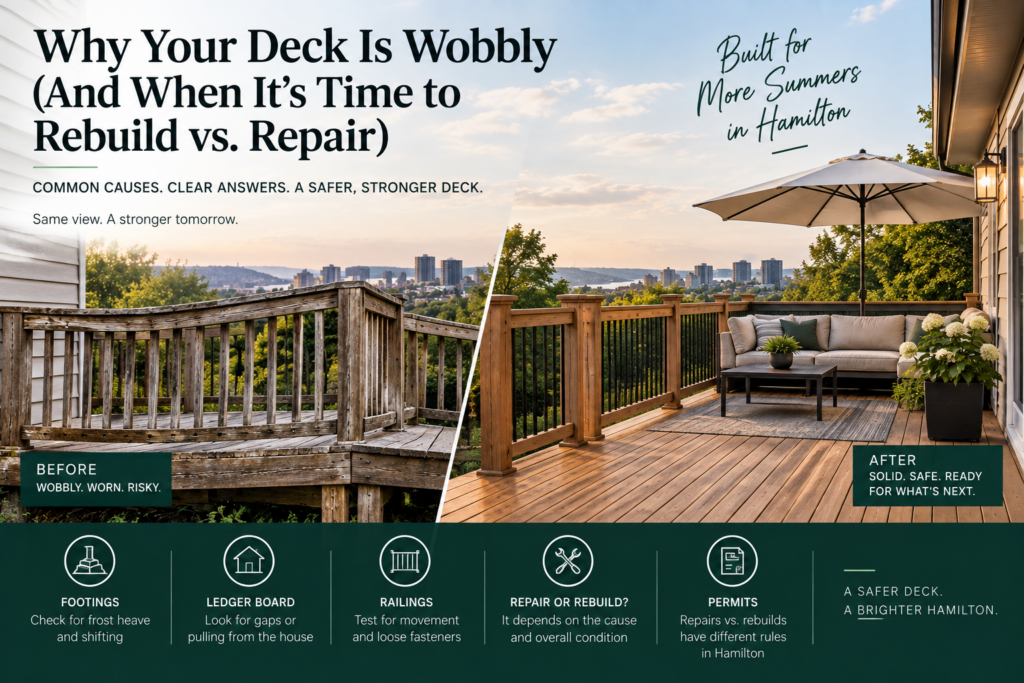
A wobbly deck is almost always caused by one of three things: footings that weren’t set below the frost line and have shifted, a ledger board that’s pulling away from the house, or railings that have loosened over time. Footing problems usually mean a rebuild, while a loose ledger board or railing can often be repaired if the rest of the structure is sound. The only way to know which one you’re dealing with is a physical inspection starting at the footings and working up.
Basement Flooding in Hamilton: Causes, Fixes, and When to Waterproof Before Finishing
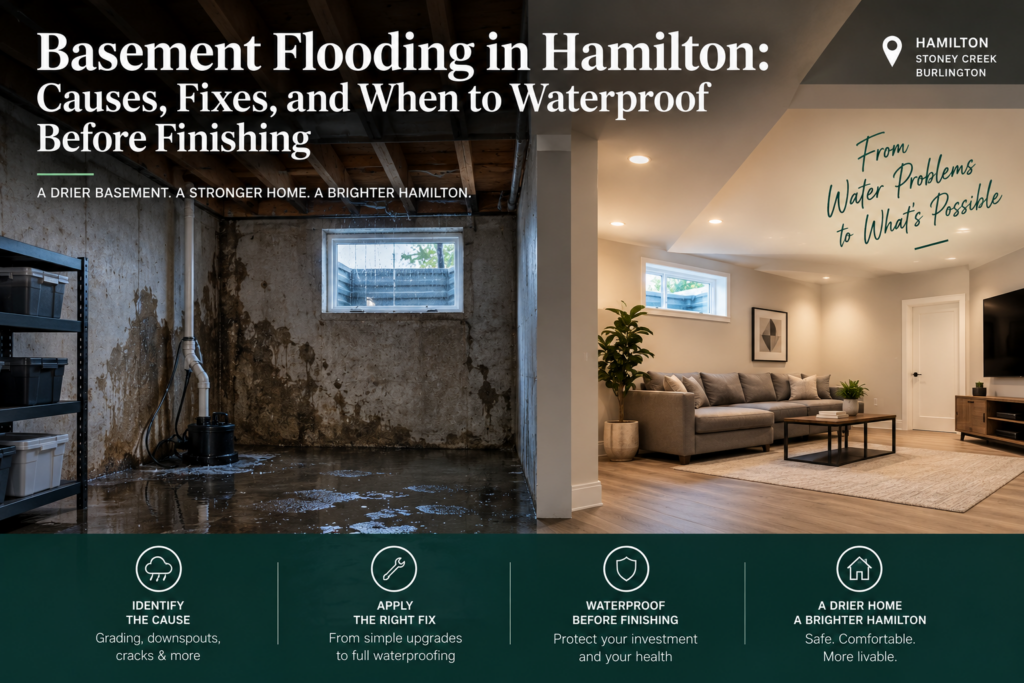
Basement flooding in Hamilton is most often caused by poor exterior grading, clogged or missing eavestroughs and downspouts, hydrostatic pressure pushing water through foundation cracks, or a failing or absent sump pump. Most cases can be resolved with a combination of exterior grading corrections, downspout extensions, foundation crack repair, and an interior drainage system paired with a sump pump. Any basement with a history of water intrusion should be fully waterproofed and confirmed dry before framing or finishing work begins, since covering a moisture problem with drywall only hides it temporarily.
How to Tell If Your Hamilton Home Is a Good Candidate for a Legal Duplex Conversion

A Hamilton home is generally a strong candidate for a legal duplex conversion if the basement has at least 1.95 metres, or about 6 feet 5 inches, of ceiling height over most of the habitable space, room for a code-compliant egress window, and a realistic path to a separate entrance. Homes built from the 1970s onward with poured concrete foundations tend to qualify most easily, though older homes with lower ceilings can often still work with additional excavation. A walkthrough with a contractor experienced in Hamilton’s Additional Residential Units bylaw is the only way to know for certain.
Flooring Installation in Hamilton: Materials, Costs & Best Practices

Flooring installation in Hamilton typically costs $6 to $18 per square foot depending on material, with laminate and vinyl at the lower end and solid hardwood at the upper end. Engineered hardwood and luxury vinyl plank offer the best balance of appearance and durability for most Hamilton homes, particularly where basement moisture or subfloor conditions rule out solid hardwood.
Home Renovation in Ancaster & Dundas: Century Homes & Custom Builds

Ancaster and Dundas are home to some of the Hamilton area’s oldest and most architecturally significant properties, where renovation work often centers on preserving original character while upgrading systems and finishes. RWF Custom Contracting specializes in century home renovation, custom millwork, and trim work suited to these neighborhoods’ craftsmanship expectations.
Home Renovation in Burlington: A Local Homeowner’s Guide

Burlington homeowners renovate under Halton Region and City of Burlington permit requirements, which run separately from Hamilton’s process but follow the same Ontario Building Code standards. RWF Custom Contracting serves Burlington with kitchens, bathrooms, basements, decks, and fences, bringing the same single-contractor accountability across every trade.
Home Renovation in Stoney Creek: What Homeowners Need to Know

Stoney Creek homeowners renovate a wide mix of housing stock, from older lakeside properties near the escarpment to newer subdivisions further inland, and project needs vary accordingly. RWF Custom Contracting handles kitchens, bathrooms, basements, decks, and fences throughout Stoney Creek, working under the same City of Hamilton permit and inspection process that applies across the amalgamated city.
Legal Duplex Conversions in Hamilton, Ontario: The Definitive 2026 Guide

A legal duplex conversion in Hamilton typically costs $80,000 to $160,000 or more, depending on the size of the unit and the scope of work required. It requires a building permit, a properly sized egress window, fire separation between units, and compliance with the City of Hamilton’s Additional Residential Units bylaw. Most conversions take 3 to 5 months from permit approval to final occupancy.
How to Add a Bathroom to a Finished Basement

Learn how to add a bathroom in a basement, with practical guidance on layout, plumbing, permits, ventilation, waterproofing, costs, and finished details.
How to Waterproof Basement Walls the Right Way

Learn how to waterproof basement walls by finding the moisture source, fixing drainage, and choosing the right interior or exterior repair plan that lasts.